Compared on 18 October 2026
opah vs Todoist
Todoist is a to-do list and task manager for work and life, quick to type into and on every device. opah is a planner for working for several companies at once: the issues assigned to you in their trackers, beside your calendar, meetings, notes and time. Here’s how they differ.
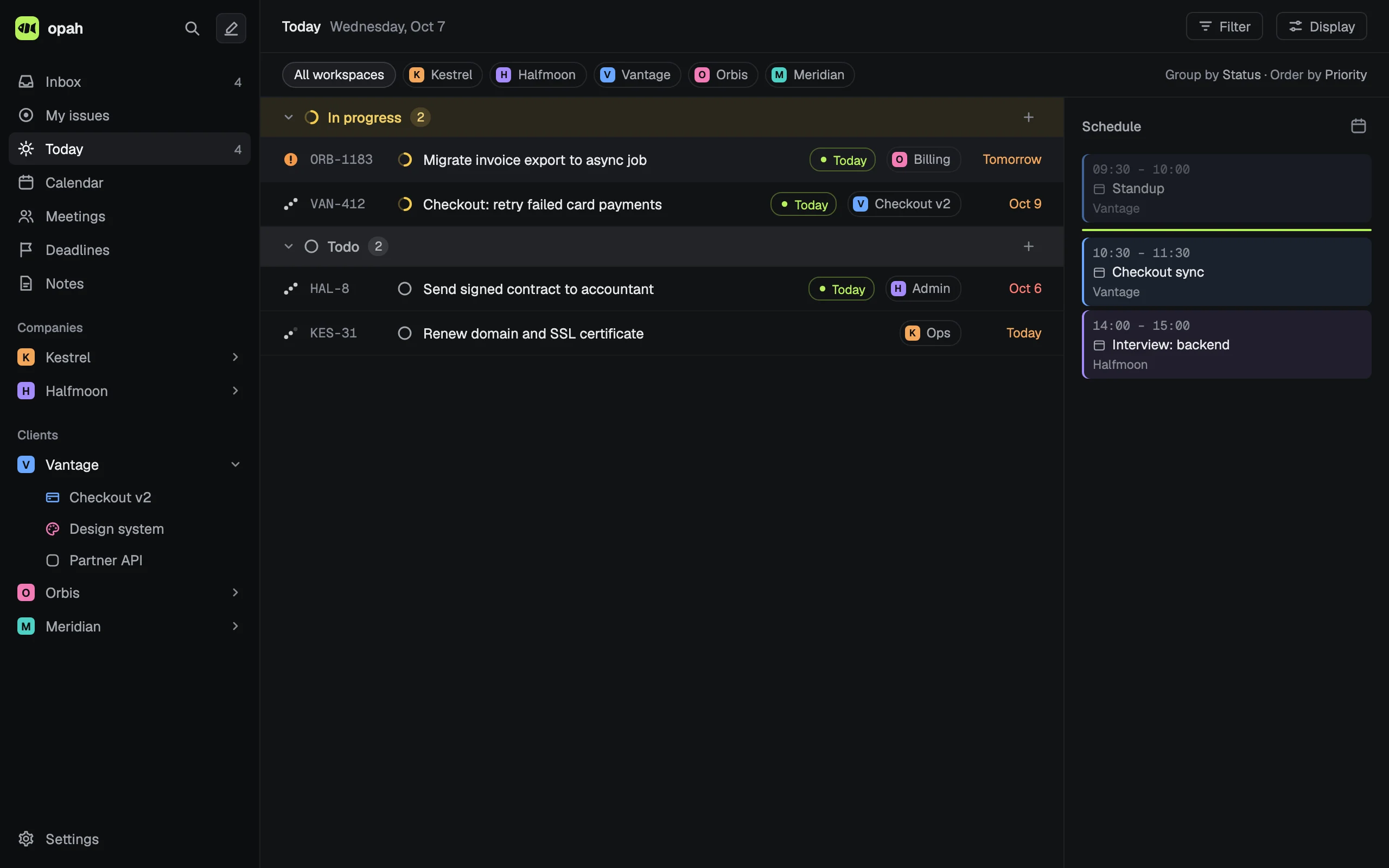
The demo runs on sample data in your browser. Nothing is saved: reload it to start over.
Side by side
| Feature | opah | Todoist |
|---|---|---|
| What it is | A personal planner for working for several companies at once: the issues assigned to you in their trackers, your calendars, meetings, notes, deadlines and time. | A to-do list and task manager for work and life: tasks with dates in projects, labels and filters, for one person or a team. |
| Separate clients | A workspace per company, each with its own projects, connections, calendars, notes and meetings. | A project per client, as its guide for freelancers suggests, with sections and labels. The free plan holds 5 personal projects, Pro 300. |
| Issue trackers | Reads the issues assigned to you from Linear, Jira Cloud, GitHub (and Enterprise Server) and GitLab (and self-managed), and tasks from a Notion database, several connections each. | Its Jira integration, set up by a Jira admin, adds one issue at a time to your Inbox as a task. GitHub and Notion only through others’ integrations in its directory; no GitLab or Linear found. |
| Written back to trackers | Only an issue’s status, and only when you turn on Send status for that connection. | Nothing found on its pages; a task added from Jira links back to the issue. |
| Calendars | Google Calendar, several accounts, both ways. No Outlook or iCloud. | One Google or Outlook account: its events show read only, and tasks with a time go to a Todoist calendar there, edits to them coming back. |
| Slack | A message you react to with an emoji becomes an issue in your Inbox, linked back to it. | A message becomes a task, and tasks can be added, assigned and completed from Slack, in one Slack workspace. |
| Notes and meetings | Markdown notes, and meetings with their agenda and notes, linked to issues with @. No recording or transcripts. | A description and comments on each task, with files. No other notes or meeting notes found. |
| Time tracking | Built in: a timer and entries on each issue. | Not built in: a task can have an estimated duration (Pro). Time tracking comes from others’ integrations, Toggl Track and Clockify among them. |
| Planning | You plan: Today, a day per issue, deadlines and estimates. Nothing schedules itself, and there’s no AI. | Today and Upcoming, dates typed in plain words, recurring tasks, deadlines (Pro), reminders, boards and filters, and AI help, Todoist Assist and Ramble. |
| Where it runs | In the browser, installable as an app on your computer. No mobile apps. | Web, desktop apps for macOS, Windows and Linux, iPhone, iPad, Android, Apple Watch and Wear OS, browser extensions, and Gmail and Outlook add-ons. |
| Price | Free for now. Later one plan: €10 a month, or €96 a year, tax included. | Beginner: free. Pro: $7 a month, or $60 a year. Business: $10 a user a month, or $8 billed yearly. |
| Trying it | A demo in the browser with sample data and no account. Once plans start, a free month first, no card. | A free plan. Pro: a 7-day trial that becomes the subscription unless canceled; Business: 14 days, with a card. No demo without signing up. |
Checked on 18 October 2026 against Todoist’s own pages, prices in US dollars as shown there. Sources: pricing, pricing FAQ, Pro trial, Business trial, freelancers, integrations, Jira, GitHub, Notion, calendars, Slack, comments, durations, time tracking, Todoist Assist, downloads.
Where Todoist fits better
- Your list is work and life together, typed fast in plain words, with recurring dates and reminders.
- You want it on your phone and watch, in desktop apps and in your email, as well as the browser.
- You want a free plan to keep, or to share projects with a team or guests.
- You’d like AI to turn what you say, an email or pasted notes into tasks.
Where opah fits better
- Your work arrives as issues in your clients’ Jira, Linear, GitHub, GitLab or Notion: opah reads those assigned to you and follows their status, priority and due date, where Todoist’s Jira integration adds one issue at a time and nothing follows it.
- You want each company as a workspace of its own, with its projects, issues, notes, meetings and calendars.
- You want time tracked on each issue and totaled per client and project, with a CSV for invoices: Todoist has no timer of its own. More on time tracking.
- Your meetings and Google calendars belong in the plan: several accounts, both ways, with each meeting’s agenda and notes.
- You’d like to try it with sample data before giving anyone your email address.
Who it’s for
Freelancers, contractors, consultants and fractional leads who work for several companies at once and sit in each one’s tools. It’s a personal planner, not a team tool: nothing to roll out to your clients, nobody to invite.
See it with sample data
The demo opens in your browser with five made-up companies’ issues, calendar, meetings and notes. Nothing to sign up for.
Try the demo, no account