Works with Notion
Your Notion tasks from every client, in one plan.
Some clients plan in a Notion database. opah reads the tasks assigned to you there and puts them beside the rest of your week: other trackers’ issues, your calendar, meetings and notes.
The demo runs on sample data in your browser. Nothing is saved: reload it to start over.
What it does with Notion
- Reads the open tasks of one database whose assignee includes you.
- You pick which properties are the assignee, status, due date, priority and project. Renaming one in Notion keeps the mapping.
- A database with a unique ID property keeps its keys, as
TASK-42; without one, tasks are numbered in your workspace. - Keeps them current while opah is open: every 2 minutes, and whenever you come back to the window. New ones land in your Inbox, so you see what arrived before you plan it.
- Title and description stay Notion’s and are read only here. Your own notes go in My notes, which never leave opah.
- Planning an issue for a day, its estimate, labels, steps, comments and tracked time are yours alone.
What goes back to Notion
Nothing, unless you turn on Send status. Then a status you set here sets the task’s status property to the matching option it already has, and that’s all: no new options, no other properties, never a new or deleted page.
Every client, one list
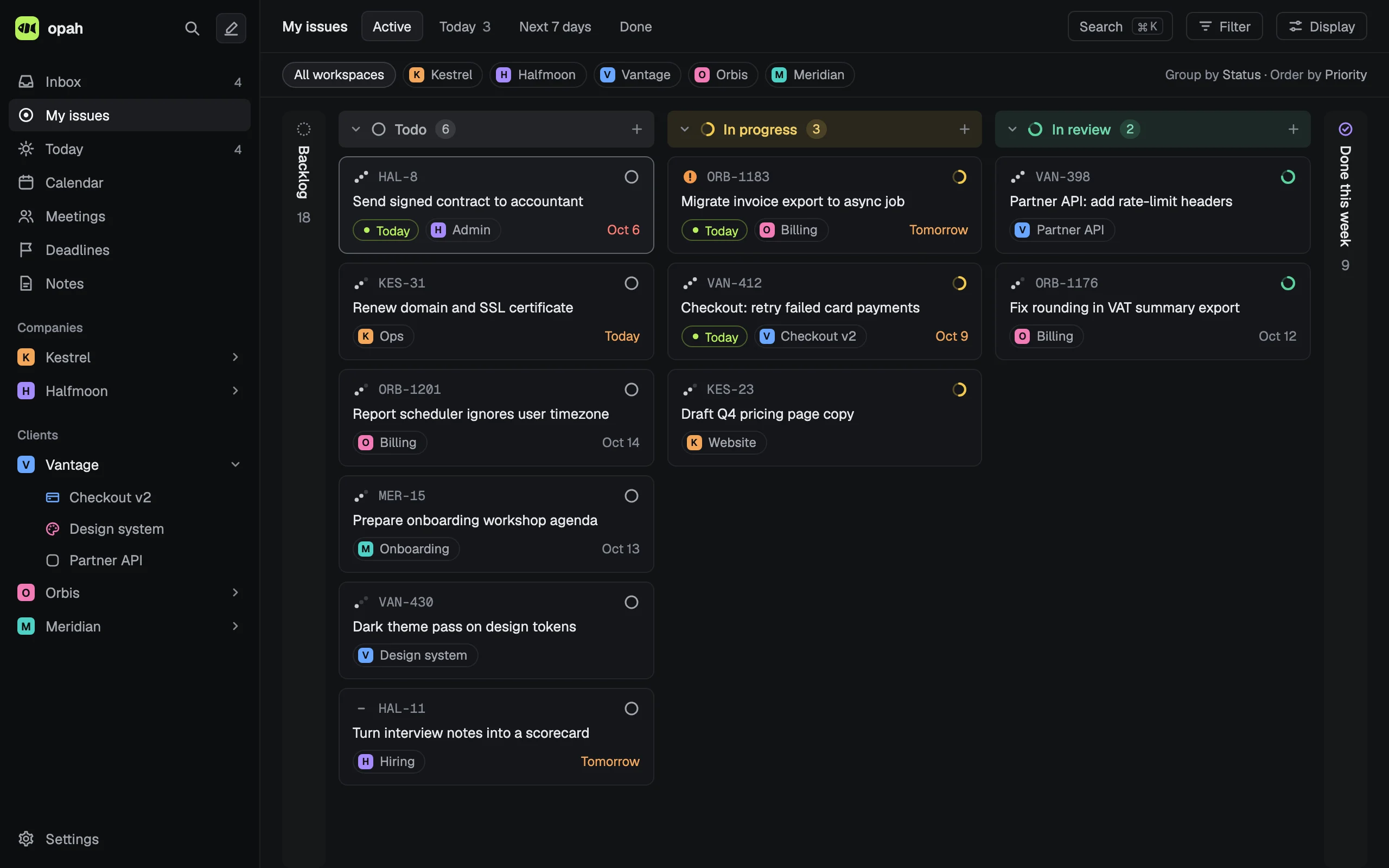
Each company you work for is a workspace with its own projects, issues, notes and meetings. Connect each client’s Notion to its workspace; another integration is another connection. Linear, Jira, GitHub and GitLab connect the same way, so My issues shows everything assigned to you, wherever it lives.
How you connect
An internal integration’s secret, made in Notion’s integration settings with Read content and Read user information (and Update content for Send status), with your tasks database shared with that integration. opah keeps the secret encrypted on its server.
Who it’s for
Freelancers, contractors, consultants and fractional leads who work for several companies at once and sit in each one’s tools. It’s a personal planner, not a team tool: nothing to roll out to your clients, nobody to invite.
The rest of the planner
- Today, an Inbox, deadlines and time tracking, as a list or a board
- A calendar with your Google calendars, where every meeting gets its agenda and notes
- Markdown notes for each company and project, linked with @ to issues and meetings
- A command palette and a keyboard shortcut for every action
- Runs in your browser and installs as an app; export everything as JSON or Markdown any time
See it with sample data
The demo opens in your browser with five made-up companies’ issues, calendar, meetings and notes. Nothing to sign up for.
Try the demo, no account